Proserv’s Chief Executive Davis Larssen has told STV News that continued political and fiscal uncertainty is driving more energy firms to focus overseas, as investment in the North Sea becomes increasingly unattractive.
Speaking during the interview, Mr Larssen said:
“Eighty per cent of our business is already outside Aberdeen. I spend a lot of time travelling to regions like West Africa and South America where clients are actively investing in infrastructure, but the North Sea is almost the opposite. Political positions taken in the UK have created an environment where people don’t want to invest.”
Proserv, headquartered in Aberdeen, is a global controls technology company and continues to expand its presence internationally. However, Mr Larssen stressed that unless the UK provides a clearer, more stable pathway for both oil and gas and renewables, there is a risk of losing skills, jobs, and investment overseas.
In this candid Q&A from the Aberdeen & Grampian Chamber of Commerce Business Bulletin, Gordon Paul, Proserv’s Global Logistics Compliance Manager, shares the personal and professional journey that took him from warehouse operations to a global leadership role. He reflects on the quiet influences of family, the power of self-driven development, and the mindset shift that transformed his leadership style. Gordon’s story is a powerful example of resilience, adaptability, and challenging the status quo to drive meaningful change.

This article is reproduced with the kind permission of Aberdeen & Grampian Chamber of Commerce. To read the article online, please click here.

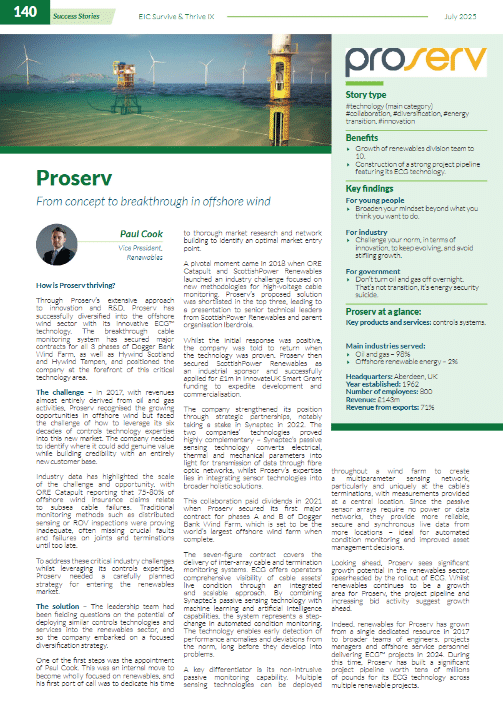
Proserv has successfully diversified from oil and gas into offshore wind by leveraging its decades of controls expertise to develop its innovative ECG™ cable monitoring technology. This non-intrusive, AI-powered system addresses a major industry challenge, subsea cable failures, and has secured key contracts on landmark projects like Dogger Bank, Hywind Scotland, and Hywind Tampen. Strategic partnerships, targeted R&D, and early market engagement have positioned Proserv as a leader in renewable subsea monitoring. Today, ECG™ is driving significant growth and a multi-million-pound project pipeline across the global renewables sector.
This article is reproduced with the kind permission of EIC. To read the article online, please click here.
With Proserv already operating facilities across the UAE, Qatar and Saudi Arabia, the collaboration will combine Brimmond’s engineering expertise with Proserv’s strong regional presence.
Northeast businesses Brimmond and Proserv have partnered to launch a new business subsidiary in Dubai focused on the Middle East.
With Proserv already operating facilities across the UAE, Qatar and Saudi Arabia, the collaboration will combine Brimmond’s engineering expertise with Proserv’s strong regional presence.
The new subsidiary will be located in the Dubai Multi Commodities Centre (DMCC), with Brimmond aiming mobilise equipment worth over £1 million for the new subsidiary.
In addition, it will provide an extensive spares and support package for rental across the UAE, Qatar, Saudi Arabia and Oman.
Brimmond designed and built four new 93kW diesel hydraulic pressure units (HPUs) at their facility in Aberdeenshire expressly for the new division. They will also be shipping Zone 1 45kW electric HPUs and Zone 2 diesel HPUs, with the first units set to be available for rental in the Middle East from July this year.
The move will help drive Brimmond’s plans to expand internationally and help it serve its clients across the region.
Brimmond managing director Tom Murdoch said: “Following a period of sustained growth in the UK, we now have capacity in the business to deliver on our plans in the Middle East. Combined with our diversification into new sectors such as renewables, defence and aquaculture, this move is a pivotal component of our growth strategy.
“Brimmond’s reputation is built on the reliability and performance of its equipment, and this same standard will be applied to the Middle East market.
“In the last calendar year alone, our rental fleet recorded 5,621 days of major equipment on hire, with only 16 days of unplanned downtime – delivering an exceptional uptime rate of 99.72%. This level of dependability ensures our clients can count on Brimmond’s equipment to perform in even the most demanding environments, reducing operational risk and maximising efficiency across their projects.”
Proserv continues to demonstrate its resilience and innovation in the Asia-Pacific region, particularly in Australia, by delivering tailored technologies that solve some of the most pressing challenges faced by offshore operators.
With a strong focus on extending the life of existing subsea assets, facilitating the transition to cleaner energy, and supporting greenfield developments, Proserv’s solutions—such as the Open Communications Hub (OCH) and Augmented Control Technology (ACT)—are helping operators overcome issues like insulation resistance, obsolescence, and costly system replacements.
“Our technologies are enabling operators to maintain production and maximize field life while keeping sustainability and economic efficiency at the forefront,” says Regional Director Luke Wassell.
By investing in local partnerships, in-region equipment storage, and cutting-edge renewables offerings like ECG™ for cable monitoring, Proserv is building a smarter, more sustainable path for the future of offshore energy.
Enhancing Safety, Accuracy, and Efficiency in Multiphase Fluid Sampling
Proserv, a global leader in controls technology, is proud to announce the launch of its groundbreaking PhaseCatcher Multi-Phase Sampling System. This innovative system addresses longstanding challenges in multiphase fluid sampling by ensuring the collection of sufficient individual phase volumes with unparalleled precision and safety.
The PhaseCatcher system incorporates patented technology that eliminates venting and the release of toxic fluids into the atmosphere, significantly enhancing operator safety and environmental compliance. By maintaining samples at flowline conditions, PhaseCatcher preserves the integrity of the sample’s chemistry, providing accurate data essential for calibrating multiphase flow meters without relying on potentially erroneous PVT modelling.
A key feature of the PhaseCatcher is the integration of Digital Guided Wave Radar Technology into Proserv’s piston sample cylinders. This advancement allows operators to verify that sufficient volumes of individual phases—oil, gas, and water—are collected during sampling. Additionally, the system enables sub-sampling of individual phases directly from the multiphase flowline, streamlining the sampling process and reducing manual handling.
The inception of the PhaseCatcher system can be traced back to an Innovation and Design Thinking workshop, part of a postgraduate diploma program. During this workshop, Richard Barr, Technical Assurance & BD Manager at Proserv, inspired by techniques taught at MIT Sloan School of Management, identified the potential of combining Guided Wave Radar from Proserv’s Mini-Separator product line with the company’s expertise in designing and manufacturing piston cylinders. This fusion of technologies led to the creation of a device capable of accurately measuring oil, gas, and water volumes while maintaining flowline conditions.
Sean Andersson, Vice President of Sampling at Proserv, commented on the launch:
“The development of the PhaseCatcher system exemplifies Proserv’s commitment to innovation and safety. By integrating advanced radar technology with our proven piston cylinder design, we’ve created a solution that not only enhances the accuracy of multiphase sampling but also prioritizes operator safety and environmental responsibility. This system represents a significant leap forward in obtaining reliable fluid properties for multiphase flow meter calibration directly at flowline conditions.”
The PhaseCatcher system also features piston displacement technology for fluid disposal, eliminating the need for pressure drops or multiphase pumps. This advancement reduces unproductive time and enhances overall operational efficiency.
Proserv’s PhaseCatcher Multi-Phase Sampling System is set to redefine industry standards, offering operators a reliable, safe, and efficient solution for multiphase fluid sampling.
Proserv’s journey into the renewable energy space is a prime example of how evolution, not revolution, can drive the energy transition. By leveraging our deep expertise in oil and gas and building strategic partnerships, we have tackled a major challenge for the offshore wind industry: cable failures.
A problem that often leaves operators “blind” to the health of their systems has now found a solution in Proserv’s award-winning ECG™ high voltage holistic cable monitoring system. Developed in collaboration with industry giants like ScottishPower Renewables (SPR) and Equinor, the technology provides full visibility of cable terminations, sections, and ancillaries.
This innovative system has already been deployed on the world’s largest offshore wind farm under construction, Dogger Bank – marking a significant milestone for Proserv’s entry into the renewables market.
For Proserv, it’s not about revolution; it’s about evolving and bridging the gap between traditional energy sectors and the future of renewables. With continued support from partners and the backing of Innovate UK’s Smart Grant, they’re leading the charge in keeping offshore wind systems operational and cost-effective.
This article is shared with the permission of Insight Energy
In a compelling interview at the E-FWD studio in Aberdeen, Scotland, Davis Larssen, CEO, joined Sepi Golzari-Munro of E-FWD and Energy Voice to delve into the vital role of controls technology in driving the energy transition. While large-scale infrastructure projects like wind farms and oil platforms often take center stage, it’s the sophisticated control systems behind the scenes that ensure these assets function safely, efficiently, and reliably.
Davis highlighted how Proserv is leveraging our decades of expertise in control systems to transform offshore wind, enhance high-voltage cable monitoring, and accelerate digitalisation. By enabling operators to predict failures before they occur and bolster energy security, Proserv is redefining what’s possible in the evolving energy landscape.
Watch now to discover how cutting-edge controls technology is shaping the future of energy!
Angus Rodger, VicePresident, Services provides a thought leadership feature for Oil & Gas Middle East, highlighting Proserv’s pioneering role in the region’s energy sector. In the piece, Angus discusses the company’s strategic growth across Dubai, Abu Dhabi, Dammam, and Qatar, as well as its commitment to delivering advanced control, sampling, and metering solutions. He also emphasizes Proserv’s focus on innovation, service excellence, and building strong partnerships to enhance asset reliability and drive operational efficiency for its clients.

- ECG safeguards the continuity of offshore wind operations for stable clean power generation to six million UK homes
In what is believed to be a global industry-first, Proserv’s advanced Electro Cable Guard (ECG™) will de-risk offshore wind operations at the third phase of Dogger Bank Wind Farm by identifying signs of transmission cable failure far earlier, allowing proactive measures to be carried out to avoid costly outages.
Under a contract with DEME, the subsea controls technology specialist will deploy its proprietary game-changing technology at the third phase of what will become the world’s largest wind farm once operational, enhancing asset reliability through earlier failure detection and prevention.
Using unique passive electrical sensors to monitor inter-array cables and terminations, ECG delivers early fault detection that traditional systems overlook, transforming maintenance strategies and strengthening resilience in offshore operations. It works by permanently and synchronously monitoring the combined effect of electrical and mechanical stresses on power cables and terminations to identify failure precursors far earlier, providing real-time insights into transmission system health. Without needing additional power or telecoms infrastructure, it is efficient, easy to deploy, and ideal for offshore cable systems, including both cables and terminations.
Building on the momentum of the global control technology specialist’s growing renewables portfolio, Proserv’s ECG is currently being deployed at Dogger Bank A and B, as well as Hywind Scotland and Hywind Tampen, with additional projects in the pipeline. This next-generation cable monitoring methodology will now be rolled out at Dogger Bank C, a further large-scale project for Proserv’s propriety technology, continuing ECG’s adoption by the offshore wind sector.
Proserv’s Vice President of Renewables, Paul Cook, said: “We are incredibly proud to secure this contract, positioning Proserv as the cable monitoring provider for DEME Offshore across the three phases of the Dogger Bank project, the world’s largest offshore wind farm currently under construction.
“As more offshore wind developments come online, unplanned cable and termination failures are an increasing concern. This latest evolution of our breakthrough ECG system offers substantial cost savings benefits to developers and operators, addressing the widespread issue of cable failures, which account for approximately 80% of wind-farm related insurance claims. Unlike conventional methods, our solution embeds passive optical electrical sensors directly within terminations, eliminating the need for additional power and telecoms infrastructure at each termination point. This enhances efficiency, streamlines data collection, and provides real-time alerts to prevent downtime, reducing repair costs by up to 80% when interventions are planned proactively.”
Located 130km off the Yorkshire coast, the Dogger Bank Wind Farm is being built in three phases with 277 turbines in total (95 at both A and B, and 87 at C), each standing 260m tall – twice the height of the London Eye. Set for completion in 2027, it will become the world’s largest offshore wind farm, powering six million UK homes with clean energy annually.
Dogger Bank Wind Farm Senior Project Manager, Alan Evans, said: “Availability of assets is critical to the efficient supply of renewable electricity into our decarbonised energy system. We’ve been working with DEME and Proserv to pioneer the use of ECG monitoring technology on the first phases of our project, and we look forward to building on this relationship with Dogger Bank C.”
Proserv’s ECG is completely wind farm agnostic with its adaptability spanning new and existing fixed-bottom and floating wind projects. It addresses up to 90% of common cable system failure modes, particularly at cable terminations, a leading cause of where faults arise. Developed in collaboration with Synaptec, a specialist in power system monitoring in which Proserv is a shareholder, the technology combines the firm’s expertise with Proserv’s engineering and integration expertise honed in oil and gas, delivering enhanced reliability for renewable energy infrastructure projects.
Synaptec’s Chief Executive Officer, Dr Philip Orr, said: “We’re excited to work with Proserv to lead the way in derisking offshore power generation. The future of clean energy depends on reliably transporting renewable power to the grid, and that means taking action to maximise the resilience of offshore power assets. This project will be a significant milestone in the development of the offshore wind sector, and we are proud to play our part in making it as successful and productive as possible.”
The Dogger Bank C contract will be project managed, engineered and delivered by Proserv’s Great Yarmouth based team, in addition to the work being carried out at the wind farm’s A and B phases.